About us
At the historic Grebswarden anti-aircraft command post, we operate a military history museum focused on German military history and the Second World War. Across more than 500 m² of exhibition space – spread over 13 rooms and several corridors – visitors can explore an extensive collection of military and contemporary historical artefacts dating from 1870 to 1989. The original naval anti-aircraft command post from 1941/42 forms the authentic centre of the exhibition. It is a rare surviving relic of the air war at the mouth of the Weser River, as many comparable command posts in the region were demolished by the Allies after the war. Using original artefacts and accompanying documentation, we illustrate the development of anti-aircraft defence (Flak) as well as the historical background of the bombing war during the Second World War.
Among the thousands of exhibited items are more than 300 uniform mannequins, historical small arms, equipment, technical devices, aircraft engines, personal objects, as well as numerous documents and contemporary testimonies representing over a century of German military and social history. The collection is continuously expanded.
A special feature of the museum is the tower platform at a height of 26 metres. From there, visitors enjoy a wide view over Butjadingen, Nordenham, the skyline of Bremerhaven, and the fortress islands Langlütjen 1 and 2 located at the mouth of the Weser.
Our work focuses on conveying history objectively and in its original location. The museum offers a direct and unfiltered insight into military developments, technical processes, and their impact on people's lives — clearly, accessibly, and embedded within its regional context.
With the outbreak of the Second World War on 1 September 1939, the German North Sea coast quickly became a focal point of air-war planning. The ports and naval facilities in Wilhelmshaven, Bremerhaven, and along the Weser estuary were considered strategically important targets. While Allied air forces initially carried out mainly reconnaissance and leaflet missions over northern Germany, the region increasingly came under bombardment as the war progressed. This made it necessary to secure the coastline with a tightly interconnected anti-aircraft defence belt.
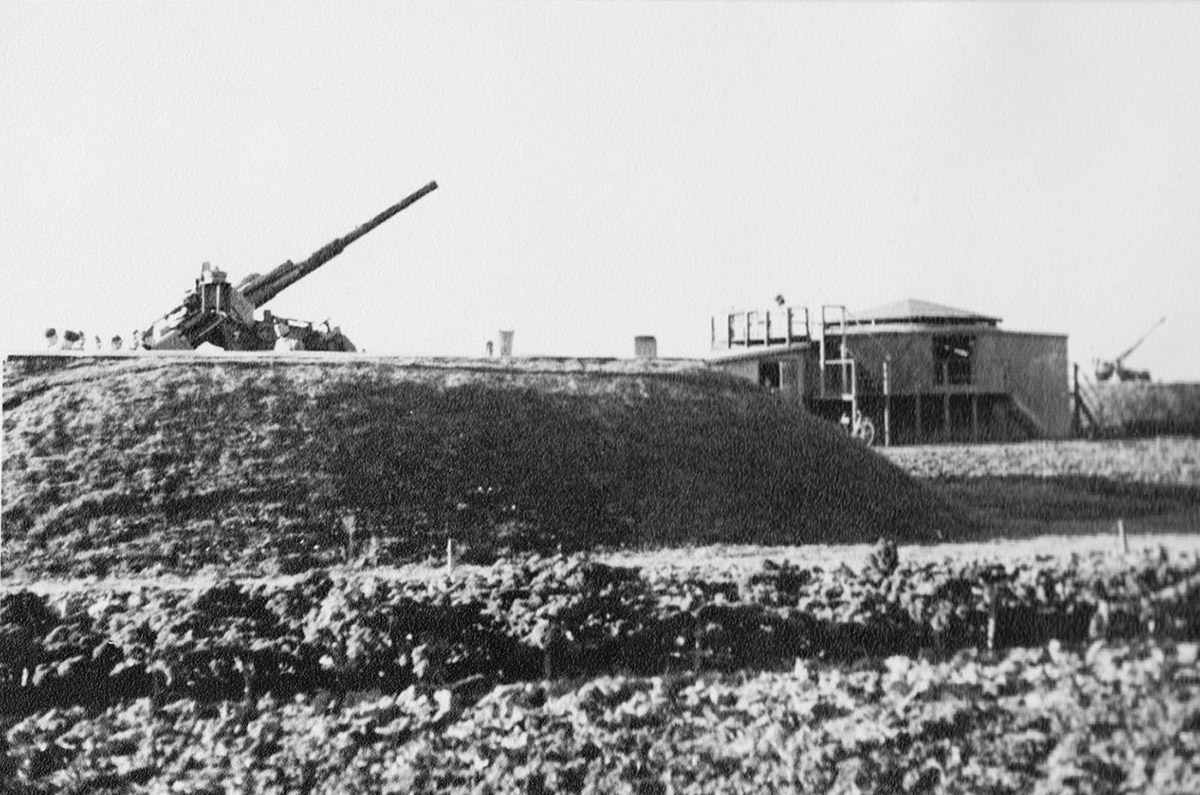
The building that now houses the museum was constructed in 1941/42 as the naval anti-aircraft command post (“Marine-Flakleitstand”) of Naval Anti-Aircraft Unit 264. From this tower, several heavy and light anti-aircraft batteries around the Weser estuary — including positions in Grebswarden, Langlütjen I, Ellwürden, Lune, and Stotel — were directed.
The command post was part of a larger defensive zone intended to protect ports, shipyards, submarine facilities, and industrial sites along the Weser estuary.
The area became a major approach corridor for Allied bomber formations. Many attacks by the Royal Air Force and later the U.S. Air Force came from the North Sea, following the coastline directly toward the region’s ports and industrial complexes.
Early-warning reports came from:
- radar stations in occupied Belgium and the Netherlands
- Luftwaffe radar positions along the German North Sea coast
- acoustic detection devices, observation posts, and optical instruments
The region was particularly at risk due to its concentration of:
- strategically important harbour facilities
- shipyards and shipbuilding
- aircraft and metal industries
- naval installations.
The command post itself was a multi-storey operations and reporting centre. Inside, all relevant information came together:
- reports from radar, acoustic devices, and optical observers
- plotting of aircraft movements on the map table
- calculation of flight paths using timing instruments
- derivation of firing commands for the connected batteries
- transmission of orders via telephone and radio
Today, the tower is one of the few surviving technical structures that allow the operational processes of wartime air defence at the Weser estuary to be understood.
After the end of the Second World War, the former command post in Grebswarden was initially used for various civilian purposes. For a time, the building served as emergency accommodation for refugees and displaced persons. Later, the Technisches Hilfswerk (THW) — the German Federal Agency for Technical Relief — used the tower for its operations. Despite these post-war uses, the structure remained largely intact and still preserves many original features.
In the early 2000s, the idea arose to establish a museum inside the historic tower.
Three private military-history collectors sought an appropriate location to make their extensive collections of uniforms, documents, equipment, and historical artefacts accessible to the public.
The command post offered ample space and an authentic historical setting closely connected to the air-war history of the Weser estuary.
In 2004, after renovation and restoration work, the museum was officially opened.
Two of the original founders continue to operate it today. Since its opening, the collection has grown steadily and now covers numerous topics from 1870 to 1989, including:
- German military history from the Imperial Era to the Cold Warg
- the air war and the role of coastal defence
- the development of anti-aircraft and air-defence systems
- special exhibitions on the end of the war in 1945, everyday life in the “Third Reich”, minesweeping units, and regional aspects of wartime and post-war historyt
- eyewitness accounts and local memories
Today, the museum combines the preserved wartime structure of the tower with a comprehensive exhibition that clearly illustrates military, technical, and societal developments. The authentic atmosphere of the building provides a direct and tangible insight into the history of the region during the war and the post-war period.